Building an Autonomous Quote-to-Order Operation with Agentic AI

In many manufacturing organizations, generating a complex quote can require coordination across sales, engineering, finance, procurement, and operations teams. A single pricing exception can add days to the approval cycle. Navigating the quote-to-order (Q2O) journey—from understanding customer needs and pricing to approvals and fulfillment—can feel like a maze for enterprises. Disconnected systems and manual handoffs often keep sales teams busy with internal coordination instead of customer engagement.

As product portfolios expand and customer expectations rise, even simple quotes can become time-consuming. Traditional automation handles repetitive tasks but struggles with complex decisions and exceptions across systems.

Agentic AI offers a way forward. By bringing together specialized AI agents, businesses can streamline Q2O activities, reduce delays, and improve order accuracy while keeping people in control of critical decisions.

What Makes Agentic AI Different?

Traditional automation follows predefined rules, while conventional AI analyzes information and provides recommendations. Agentic AI goes further by understanding context, making decisions, and coordinating actions across enterprise systems.

Consider a customer requesting a special discount. An AI agent can review contract terms, assess margins, check pricing policies, and determine the next step. Within defined business rules, it can take an authorized action or escalate the request to a human approver with a clear explanation.

This moves businesses beyond automating individual tasks toward managing end-to-end outcomes.

Why Traditional Q2O Processes Struggle

The biggest challenge in Q2O is not creating quotes but managing the decisions, approvals, and dependencies that surround them. Some of the challenges are:

How Agentic AI Enables Autonomous Q2O

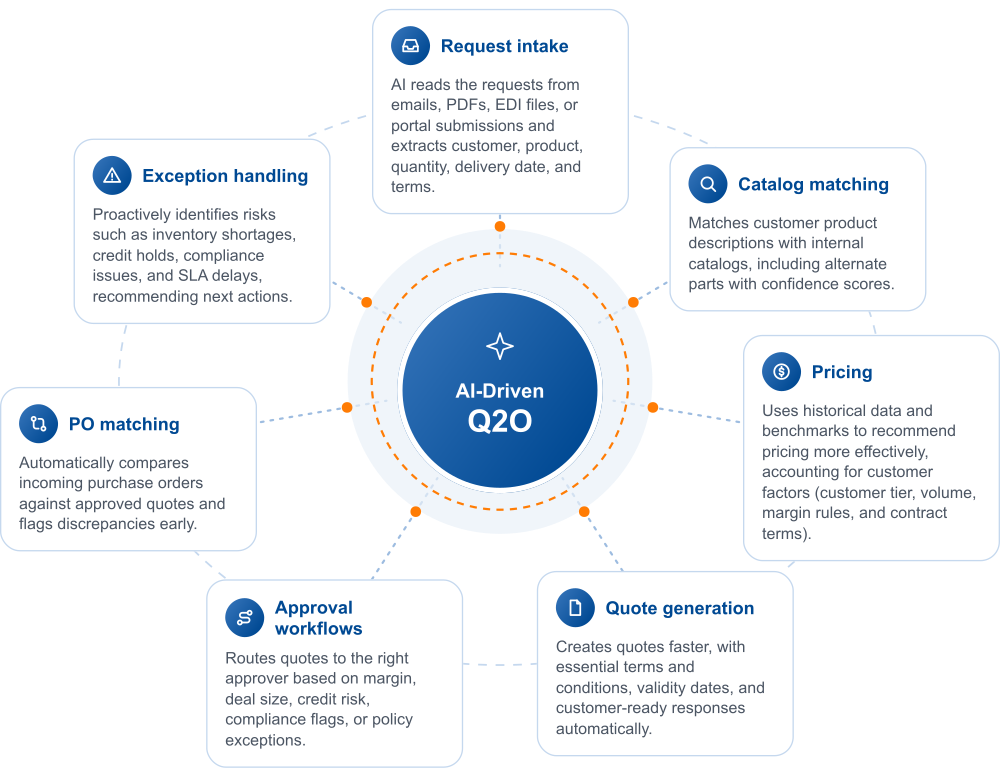
Specialized AI agents can work together to automate and optimize every stage of the Q2O journey.
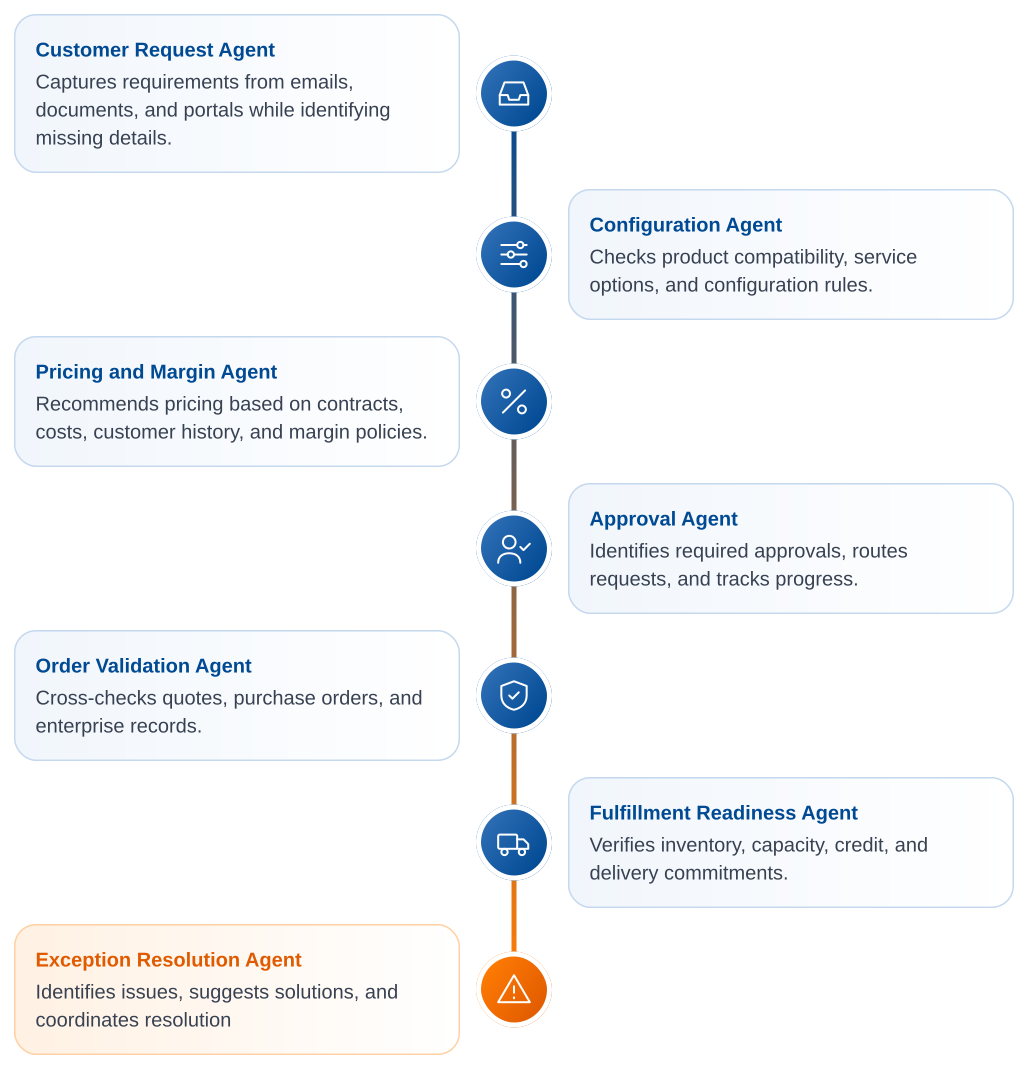
For instance, a customer requesting a complex product configuration with an urgent delivery date. Instead of contacting multiple teams, the sales representative receives a consolidated recommendation as agents check compatibility, inventory, pricing, and contract terms in parallel. Routine tasks can proceed automatically within approved limits, while sensitive decisions remain under human oversight.

Business Benefits of Autonomous Q2O

By reducing manual effort and improving coordination, autonomous Q2O can deliver:

Topaz AI Next Q2O: Orchestrating End-to-End Autonomous Quote-to-Order

Topaz AI Next Q2O brings a single orchestration layer across CRM, CPQ, PLM, and ERP systems, turning customer requests into accurate, validated, sales-ready quotes and orders.

It turns quoting from a manual task into an autonomous sales engine: configuring, pricing, negotiating, and routing every quote from start to finish, so sellers focus on winning deals, not navigating processes.

Value Delivered: Topaz AI Next Q2O enabled a leading industrial manufacturer for datacenters to streamline RFQ-to-Award processes through AI-driven automation, achieving 45% faster sourcing cycles and 21% productivity gains.

Steps to Transition from Manual to Fully Autonomous Q2O

A phased approach helps businesses introduce agentic AI while managing operational risks.

Employee involvement, transparent decisions, and clear accountability are essential for building trust and encouraging adoption.

The Future of Q2O

The organizations that gain the most from agentic AI will be those that treat Q2O as a strategic revenue process rather than a sequence of disconnected tasks. By bringing intelligence and orchestration into every decision point, businesses can accelerate growth while maintaining control and compliance.

With AI handling everyday coordination, sales teams can spend more time on complex deals and customer relationships. The result is a more responsive Q2O process that helps businesses make informed decisions, improve order accuracy, and convert opportunities into orders faster.

Ready to transform your quote-to-order operations?

Discover how Topaz AI Next Q2O can help streamline workflows, accelerate quote-to-order cycles, and improve accuracy with agentic AI.
Integrating ERP with Agentic AI for Seamless O2C Operations

Traditional ERP systems have, no doubt, powered businesses across industries, streamlining operations and integrating core processes. However, with technological advancements, increasing business complexity, and the rise of data, ERP systems face significant challenges, from a lack of governance to the chaos of siloed information.

Enter the game changer: agentic AI. With AI investments ramping up, forward-thinking enterprises today are looking to harness the power of agentic AI to breathe new life into their ERP systems.

How can businesses successfully navigate this shift and scale ERP transformations? How can AI agents collaborate with ERP systems to facilitate real-time orchestration? This blog explores the dawn of the agentic ERP era, where AI agents can think, act, and adapt autonomously, thereby strengthening a company’s competitive advantage. Read on to discover how integrating agentic AI into ERP can redefine success and empower enterprises to thrive in a dynamic environment.

Roadblocks with Traditional ERP

Organizations typically encounter the following ERP limitations in Order-to-Cash (O2C) process:

Business Impact

Traditional ERP vs. Agentic AI Systems

Traditional ERP systems are engineered to be systems of record. They excel at standardized process flows, applying business rules and maintaining transaction integrity, but they largely operate in predefined workflows.

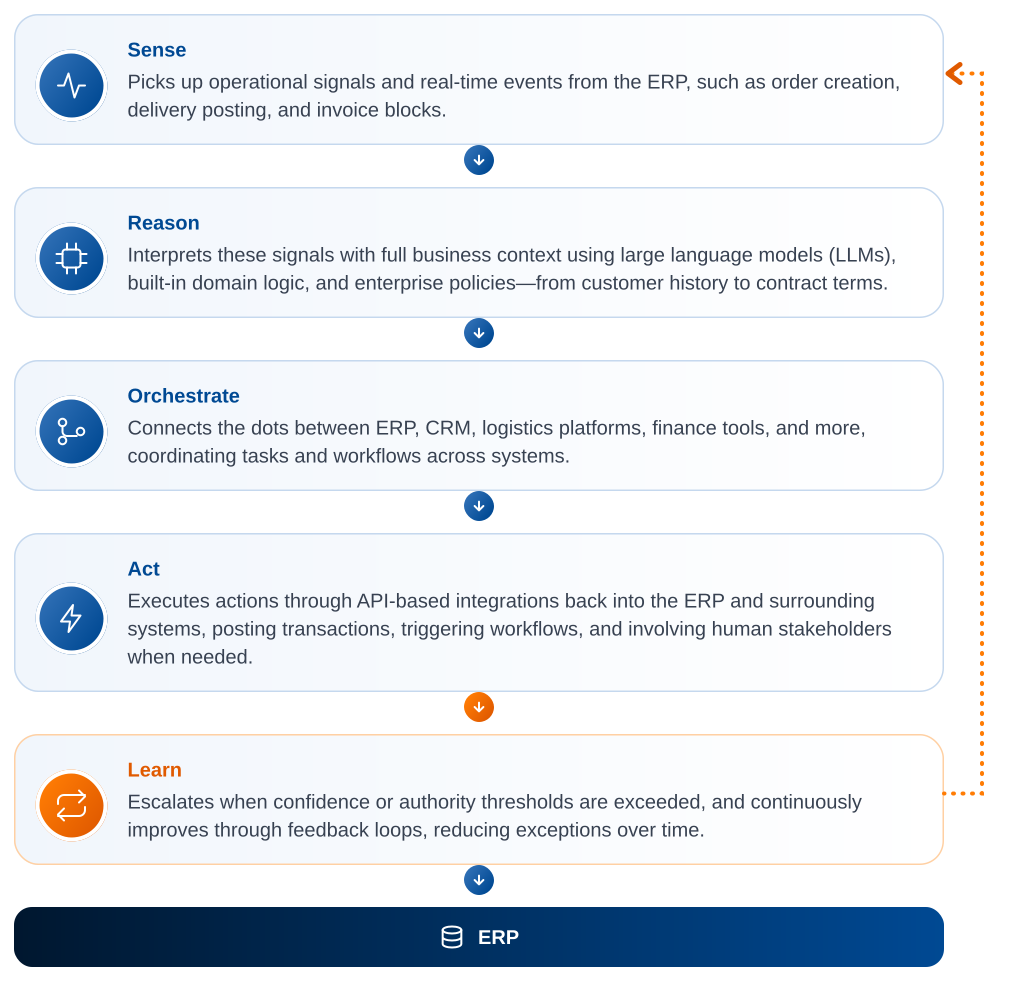
Agentic AI systems, by contrast, are systems of action. Rather than replacing ERP, agentic AI forms a cognitive execution layer that can observe events, reason about next best actions, coordinate across systems via Application Programming Interfaces (APIs), and execute multi-step workflows.

Moreover, traditional ERPs struggle with complex, multi-factor decisions (such as balancing revenue, customer priority, and supply constraints), cross-system dependencies, and unstructured inputs such as emails, contracts, and conversations.

Agentic AI steps in to handle exceptions that typically involve hours of manual effort, such as:

Reimagining ERP with Agentic AI

Agentic AI adds a new dimension to ERP by embedding intelligence directly into workflows such as approvals, planning, forecasting, and exception handling, driving adoption and impact.

Agentic AI integrates with ERP using a non-intrusive, layered architecture:

Advantages of Agentic AI in O2C

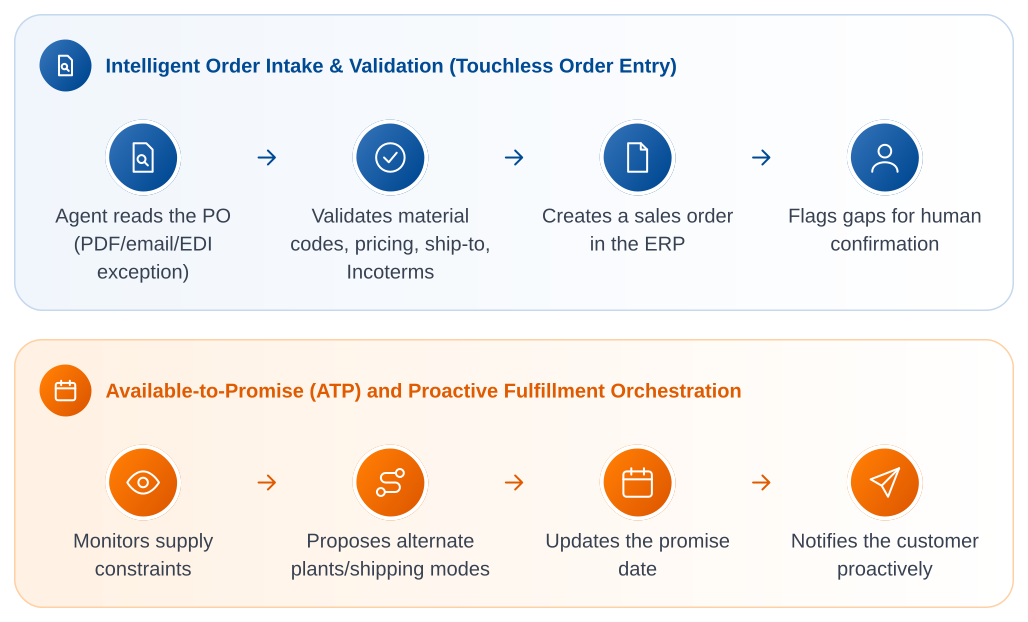
O2C Use Cases Enabled by Agentic AI in ERP

Conclusion

Traditional ERP remains the operational backbone, continuing to serve as the system of record while agentic AI becomes the system of action. Yet modern O2C performance demands more than transaction processing; it requires real-time sensing, cross-system coordination, and intelligent exception handling.

This is where a unified AI platform comes in. Infosys Topaz AI Next provides the orchestration and governance layer, helping enterprises operationalize agentic workflows on top of ERP, connecting data, processes, and human approvals into a controlled, auditable execution fabric.

The next era of O2C is clear: ERP powered by AI agents, making operations smarter, faster, and more efficient.

Ready to integrate ERP with agentic AI?

From Data Collection to Screening: Agentic AI Across the KYC Lifecycle

Banks face growing KYC volumes, stricter regulation, and more sophisticated fraud, and traditional, manual KYC is struggling to keep up. Agentic AI offers a faster, more efficient model: agents handle the heavy lifting of collection, extraction, and screening, while people focus on exceptions, judgment calls, and approvals.

Let’s walk through each stage, starting with how data is collected.

Data Collection

Traditionally, data collection means getting documents or data from different sources. AI agents can instead proactively pull the data from accredited sources such as company registry, credit bureau, corporate websites, and jurisdiction-specific portals, rather than relying entirely on what the customer provides.

For corporate clients, an agent can automatically fetch incorporation documents, stakeholder registers, filing histories, and regulatory filings such as 10-Ks and 8-Ks. Hence, automated doc collection can retrieve documents in hours, whereas a manual process can take several days.

Data Extraction

KYC documents are often complex and inconsistently structured. KYC checkers have to read documents and pull necessary information or key attributes from the documents. This process used to be entirely manual, slow, and error-prone with users retyping information from scanned PDFs into internal systems.

AI agents can use document intelligence to extract information from scanned files, handwritten forms, and low-quality images, turning complex documents into usable, structured data. But extraction is only part of the job. The same process can cause inconsistencies that deserve a closer look. A name on a passport may not quite match the one on a utility bill. An address may differ across company filings. A document may show signs of alteration. Instead of allowing these discrepancies to pass unnoticed, the agent can route them to an analyst for review.

Screening: Adverse Media, Sanctions, and PEP

Once the relevant data has been collected and structured, screening can begin. Rather than treating adverse media, Politically Exposed Person (PEP) Identification, and Sanctions List screening, UBO identifications as separate checks, agents can initiate them in parallel, using the same verified entity information as their starting point.

Efficiency Gains with Agents led KYC process

The potential efficiency gains are significant. A study on agent-led, human-in-the-loop KYC system suggests it can lower modeled cost and manual effort by 62.9% while keeping people focused on exceptions, judgments and approvals. Data Collection, Extraction, Screening together represents 65.4% of current manual labor cost.

Key benefits include:

Conclusion

With growing KYC volumes, regulatory scrutiny, and increasingly sophisticated fraud, the opportunity in KYC is not simply to automate more steps; it is to change where human effort is spent.

Agent-led KYC changes that. Agents can take on much of the work involved in collecting documents, extracting information, checking entities, and continuously monitoring change. Analysts step in when a case needs investigation; an exception needs resolving, or a decision requires judgment.

The result is a KYC process designed to handle greater volume without taking accountability away from the people responsible for the final decision.

Ready to modernize your KYC?

Get in touch with our experts to find out what agent-led KYC could look like for your business.

Deduction Management in O2C: How to Automate Dispute Resolution and Recover Revenue

Every year, organizations lose millions in working capital because customer deductions (Customers paying less than the billed amount) remain unresolved, under-disputed, or are written off without proper validation. While many deductions are legitimate, a significant percentage result from pricing discrepancies, duplicate claims, unsupported shortages, compliance disputes, and process errors. The challenge is not only identifying deductions, but also resolving them quickly enough to recover revenue before recovery windows expire.

What Are Deductions and Why Do They Matter?

Every business runs into situations where customers deliberately withhold payments due to various reasons – often without sufficient documentation. This short payment is called a “Deduction”.

This can happen due to various reasons, such as:

How Are Deductions Managed Today?

The AR team today chases customers to investigate the reason for the short payment and try to recover it. When the parties disagree , a dispute must be raised and resolved.

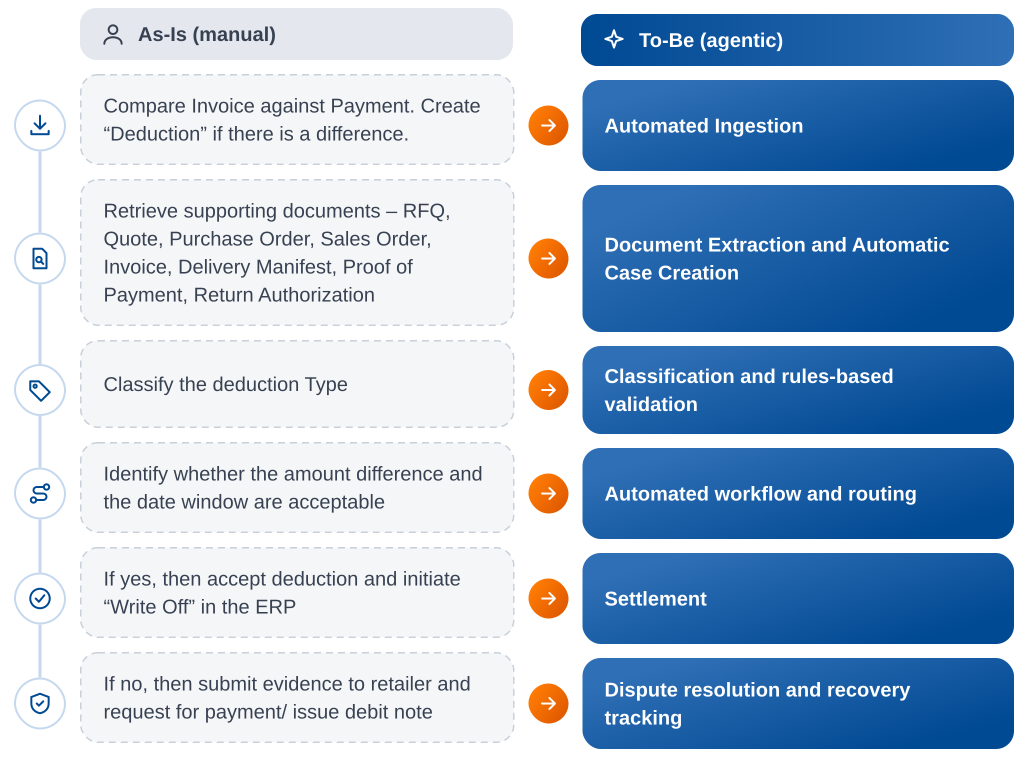
Every deduction requires the analyst to manually retrieve and reconcile documents from multiple sources (RFQ, Quote, Purchase Order, Sales Order, Invoice, Delivery Manifest, Proof of Payment, Return Authorization, and so on).

While the process is straightforward, executing it is tedious, ad hoc, manual, and time-consuming because these are exceptional scenarios.

The problem gets even harder because deductions are exception-based events. Volumes can fluctuate significantly, making it difficult to maintain dedicated teams that can rapidly investigate every claim. As deduction backlogs grow, recovery windows may expire before analysts have an opportunity to act.

The result is:

Why Is It a Candidate for Agentic Implementation

This makes it an ideal candidate for an agentic solution because agents can replace each deterministic step, with a human- in- the- loop to validate the deductions at the end.

The system can initiate the creation of the deduction without waiting for an analyst to raise it.

Business Outcomes of AI-Driven Deduction Management

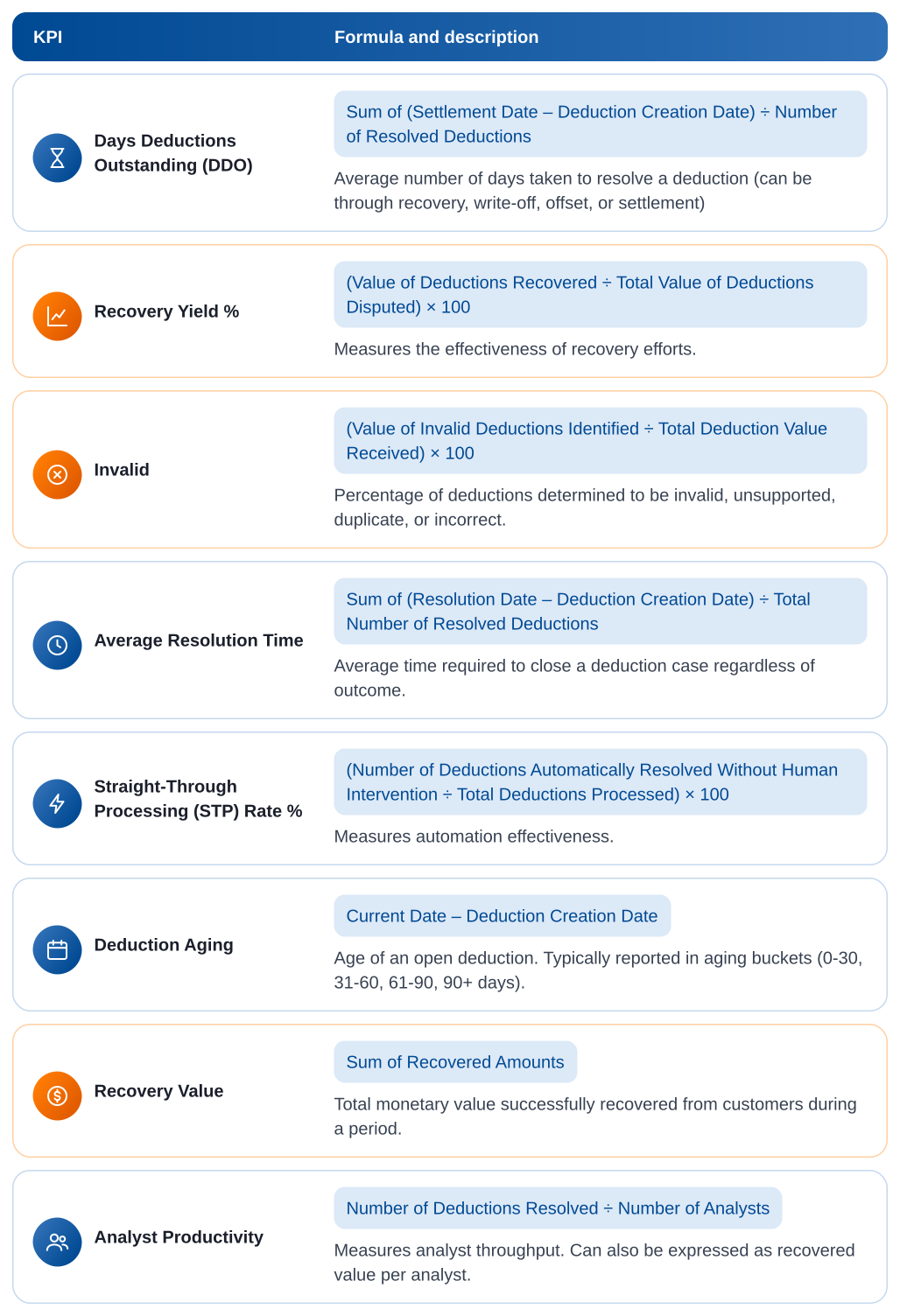
Measuring Success: KPIs That Matter

Turning Revenue Leakage into Working Capital Gains

Today, deduction management is an Accounts Receivable function. However, it has the potential to protect revenue, improve cash flow, and optimize working capital.

Organizations that continue to rely on spreadsheets, emails, and manual investigations will struggle to keep pace with increasing deduction volumes and shrinking recovery windows.

By combining workflow automation, intelligent document processing, business-rule validation, and Agentic AI, enterprises can automate dispute resolution, recover revenue faster, and gain complete visibility into the deduction lifecycle.

The future of deduction management is not simply processing deductions more efficiently. It is transforming deductions from a revenue-leakage problem into a working-capital optimization opportunity.

Ready to transform your deduction management process and recover more revenue?

Contact our team today to discover how AI-driven deduction management can maximize your working capital, accelerate dispute resolution, and improve recovery outcomes.

From Periodic Reviews to Perpetual KYC: The Future of Compliance

Financial institutions are moving past legacy Know Your Customer (KYC) systems and calendar-based review cycles, building more agile architectures that keep up with compliance demands while reducing operational effort.

Data analytics, AI, workflow automation, and real-time screening are no longer experimental add-ons. At this point, they’re just what modern KYC looks like.

Due to tighter regulatory expectations, evolving customer risk profiles, and compliance budgets under constant pressure, more institutions are switching to an event-driven model for better risk management and more effective compliance.

In this blog, we’ll discuss why modernizing KYC matters now, the challenges many institutions face, and the broader shift toward perpetual KYC.

The Evolution of KYC

KYC is the process of verifying customer identities, assessing risks, and continuously monitoring customer activities throughout the relationship lifecycle. It is critical because it helps financial institutions prevent money laundering, fraud, sanctions violations, and other financial crimes while meeting regulatory requirements and protecting their reputation.

KYC today has evolved from manual, document-based onboarding and periodic reviews to perpetual KYC. Event-driven risk management aims to help improve compliance effectiveness, operational efficiency, and customer experience.

The Limitations of Periodic KYC Reviews

Periodic or Regular KYC reviews bring a host of challenges because they rely on fixed schedules, creating long gaps where changes in a customer’s risk profile go undetected. This creates compliance blind spots, review backlogs, duplicated effort, unnecessary document requests, and higher operational costs from review campaigns.

These challenges include backlogs, repeated document requests, duplicated effort, and delays that put organizations at risk of running into regulatory issues or, worse, financial penalties. Customers are asked to provide documents and information already on file, causing frustration and delays.

Defining Perpetual KYC: What Is It and Why Now?

Perpetual KYC is a continuous, event-driven approach to customer due diligence in which customer data, risk assessments, and screening outcomes are automatically updated when material changes occur, rather than waiting for predefined review dates.

What makes this possible? Real-time data feeds, event-trigger frameworks, workflow orchestration, API integrations, digital identity tools, advanced analytics, AI/ML models, adverse media monitoring, sanctions screening, entity resolution, automated risk scoring.

This matters even more as regulations emphasize ongoing due diligence and keeping customer information up to date.

The Advantages of Perpetual KYC

Reduces review backlogs and manual effort
Improves compliance responsiveness and auditability
Minimizes repetitive information requests, accelerates onboarding, and creates a smoother customer service experience
Continuous monitoring enables near real-time investigation and remediation of emerging risks
The result: faster onboarding, fewer false positives, smaller backlogs, more productive analysts, lower compliance costs, and higher customer satisfaction.

Agentic AI and Automation: Enabling Perpetual KYC

Agentic AI brings specialized agents that handle research, screening, monitoring, risk scoring, and case prep on their own, as soon as something changes, without any manual trigger.

Automation handles the repetitive work underneath: pulling documents, extracting data, screening, validating, routing, reducing errors, and freeing up analysts to focus on the cases that actually need human judgment.

Challenges to Implementing Agentic AI:

Implementation Roadmap: From Legacy to Perpetual KYC

Moving from where most institutions are today to a perpetual KYC model isn’t a single leap; it requires a sequence of deliberate moves.

Conclusion: How Perpetual KYC and Agentic AI Are Shaping the Future of Compliance

Agentic AI is shifting compliance from reactive, calendar-driven reviews to proactive, intelligence-led monitoring.

Rather than a technology project, financial institutions should treat perpetual KYC as a business and operating-model transformation with strong data foundations, human-in-the-loop controls, clear governance frameworks, and a phased adoption strategy focused on measurable business outcomes.

Ready to move beyond periodic reviews?

Assess where your organization stands and what a phased path to perpetual KYC could look like.

From Quotes to Revenue: How AI is Transforming the Quote-to-Order Journey

Quote-to-order (Q2O) is the process that moves a deal from initial pricing request to a confirmed, fulfillment-ready order, covering configuration, pricing, approvals, and quote-to-order conversion. Done well, it speeds up deal closure, keeps pricing accurate, and keeps sales, finance, and operations in sync as product and pricing complexity grows.

Agentic AI is changing that. It goes beyond automating individual tasks to turning Q2O from a fragmented, error-prone process into a more connected, intelligent revenue flow. The result is a faster, more accurate Q2O cycle that frees sales teams to focus on selling, not paperwork.

In this blog, we’ll explore how AI is rewriting the rules and what it means for companies eager to turn quotes into real revenue, faster than ever before.

The “Old Way” of Quote-to-Order Vs. the “New Way” with AI

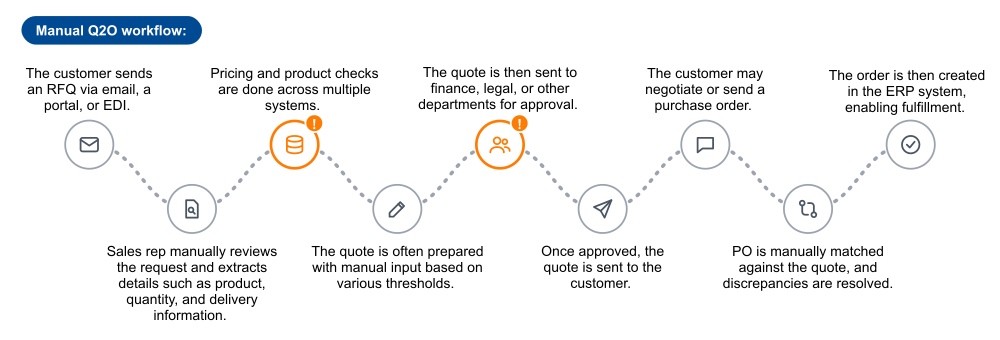
The old Q2O process was mostly manual, designed for teams to navigate the traditional quote-to-order process. Teams had to read incoming emails, extract RFQ/PO details, search product catalogs, check pricing and inventory across disconnected systems, route approvals, and finally create quotes and orders in the ERP. 

The manual Q2O journey slows down because too many critical decisions depend on manual review, email follow-ups, spreadsheet/multi-system checks, and cross-team handoffs. Moreover, a high-value quote can sit in an inbox or approval queue for days, giving competitors time to respond first and causing the customer to move on before the business even realizes the opportunity is at risk.

Whereas AI carries out all the steps while also recommending valid configurations, predicting optimal pricing, auto-routing approvals, drafting quotes in seconds, and flagging which deals are likely to convert into orders faster and with better visibility.

The Evolution of Quote-to-Order: From Manual to AI-Driven Processes

Here, delays often stem from product matching, price validation, inventory checks, and securing approvals. Moreover, when tasks are sent to different teams, for example, approvals from finance or legal, further delays can occur.

This is where AI comes in, enabling enterprises to move from automating isolated tasks to applying intelligence across the entire flow.

Where AI Is Changing the Game

AI speeds up individual steps and removes the guesswork and manual handoffs that used to slow the whole process down.

Benefits of AI-Driven Q2O Processes

Real-World Use Cases

A leading global supply chain solutions provider transformed its order-to-cash journey, lifting quote-to-order conversion by 3%, cutting quote intake effort by about 30%, and delivering in-stock quotes in under 12 hours.

Read more

Key Factors to Consider When Implementing AI-Powered Q2O

The Future of Q2O with AI

Looking ahead, Q2O automation is moving toward more agentic, end-to-end workflows, where AI doesn’t just recommend actions but actively coordinates them across systems:

Today, AI is transforming quote-to-order from a slow, manual, back-office process into a faster, smarter, and more visible revenue engine. New Gen-AI solutions also help monitor, prioritize, optimize, and accelerate quotes at every stage of the journey.

With AI in place, businesses can respond faster, reduce errors, improve pricing discipline, resolve exceptions earlier, and convert more opportunities into confirmed orders, cutting down on revenue leakage and lost deals along the way.

Turn Q2O into a true competitive advantage: faster deals, tighter margins, and a smoother customer experience.

Connecting the Dots: Transforming Fragmented Insurance Operations into Seamless Customer Journeys

A broker emails a quote request for a new client, with the supporting documents attached. Someone downloads the files, re-keys the key details, works out which product fits, and routes the case to underwriting. Underwriting assesses the risk while legal reviews compliance, often from separate copies of the same file. Days later, someone notices a required document is missing. The request goes back to the broker, and the clock restarts.

No single team failed here. Every person did their job. The journey failed in the handoffs between them.

This pattern repeats across insurance operations every day. Each stalled or returned case costs time and effort, and it can cost the broker relationship too.

Automation Built the Foundation. Orchestration Connects the Journey.

Insurers have invested heavily in modernization. They have added workflow tools, robotic process automation, document processing, and AI. Each of these investments made a task faster. Few of them made the journey shorter.

The numbers show the gap. Only about 38% of insurers and banks report capturing AI value at scale, and the main constraint is not the AI model. It is the workflow and the data around it. Automating a step does little when the case still waits in an inbox before that step and gets re-keyed after it.

Fragmentation Lives in the Handoffs

A servicing request arrives by email, a claim comes in through a portal, and supporting documents arrive by fax. Each one has to be read, checked, completed, and routed, often by different teams working in different systems. Every handoff is a point where context gets lost, errors creep in, and time passes without anyone noticing.

The cost falls on everyone involved. Employees spend their day searching across screens. Brokers and customers wait longer and get inconsistent answers. Operations leaders can’t see where work is stuck until an SLA has already been missed.

Five Stages Where Journeys Break, or Hold Together

Every insurance request, whether it is a submission, a claim, a policy change, or an enrollment, passes through the same five stages. Each stage is also a place where things commonly go wrong.

Intake. Requests arrive through email, portals, forms, APIs, and scanned paper. When each channel is handled separately, work is duplicated or lost before it starts. A single point of intake captures everything, regardless of source.

Triage. A request that reaches the wrong team, or the right team too late, has already failed. Triage classifies each request by intent and routes it based on rules, workload, urgency, and SLA commitments.

Extract. Critical information sits in PDFs, spreadsheets, and handwritten forms. Extraction turns any document format into usable business data, so no one has to re-key it.

Enrich. This is where most rework is either prevented or created. Data is validated against internal and external sources, gaps are flagged, and NIGO risks are caught before the case reaches an underwriter or adjuster.

Closure. The decision is executed, and downstream systems are updated, with minimal manual entry. The case closes with a full record of what happened and why.

A Front Door That Works With What You Already Have

Connecting the journey doesn’t require replacing core systems. The Infosys Topaz AI Next Digital Door solution for Insurance is an AI-powered system of engagement that sits alongside existing policy, claims, CRM, billing, and content platforms. It gives customers, brokers, partners, and employees a single front door, and it orchestrates each request from intake to closure.

Built on the Infosys Topaz AI Next platform, Digital Door incorporates specialized AI agents across the journey. These agents find submission gaps before work enters the pipeline, validate data against internal and external sources, surface next-best actions for decision-makers, and flag bottlenecks before SLAs slip.

Because Digital Door comes with preconfigured insurance journeys for broker submissions, policy servicing, claims, and group benefits enrollment, insurers don’t have to transform everything at once. They can start with the one journey that causes the most rework, prove the value there, and expand from that base.

When the journey is connected, the clock stops restarting!

Want to see how Digital Door connects insurance journeys from intake to closure?