Home > Blogs > Deduction Management in O2C: How to Automate Dispute Resolution and Recover Revenue
Deduction Management in O2C: How to Automate Dispute Resolution and Recover Revenue
Table of Contents
Every year, organizations lose millions in working capital because customer deductions (Customers paying less than the billed amount) remain unresolved, under-disputed, or are written off without proper validation. While many deductions are legitimate, a significant percentage result from pricing discrepancies, duplicate claims, unsupported shortages, compliance disputes, and process errors. The challenge is not only identifying deductions, but also resolving them quickly enough to recover revenue before recovery windows expire.
What Are Deductions and Why Do They Matter?
Every business runs into situations where customers deliberately withhold payments due to various reasons – often without sufficient documentation. This short payment is called a “Deduction”.
This can happen due to various reasons, such as:
How Are Deductions Managed Today?
The AR team today chases customers to investigate the reason for the short payment and try to recover it. When the parties disagree , a dispute must be raised and resolved.
Every deduction requires the analyst to manually retrieve and reconcile documents from multiple sources (RFQ, Quote, Purchase Order, Sales Order, Invoice, Delivery Manifest, Proof of Payment, Return Authorization, and so on).
While the process is straightforward, executing it is tedious, ad hoc, manual, and time-consuming because these are exceptional scenarios.
The problem gets even harder because deductions are exception-based events. Volumes can fluctuate significantly, making it difficult to maintain dedicated teams that can rapidly investigate every claim. As deduction backlogs grow, recovery windows may expire before analysts have an opportunity to act.
The result is:
Why Is It a Candidate for Agentic Implementation
This makes it an ideal candidate for an agentic solution because agents can replace each deterministic step, with a human- in- the- loop to validate the deductions at the end.
The system can initiate the creation of the deduction without waiting for an analyst to raise it.
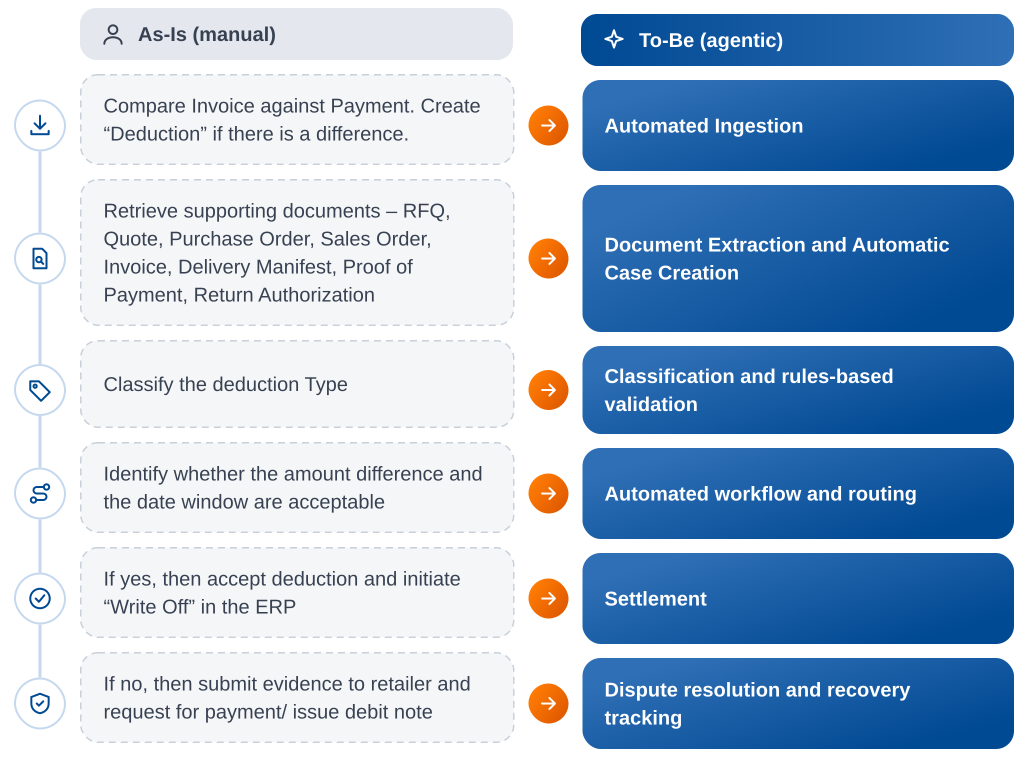
Business Outcomes of AI-Driven Deduction Management
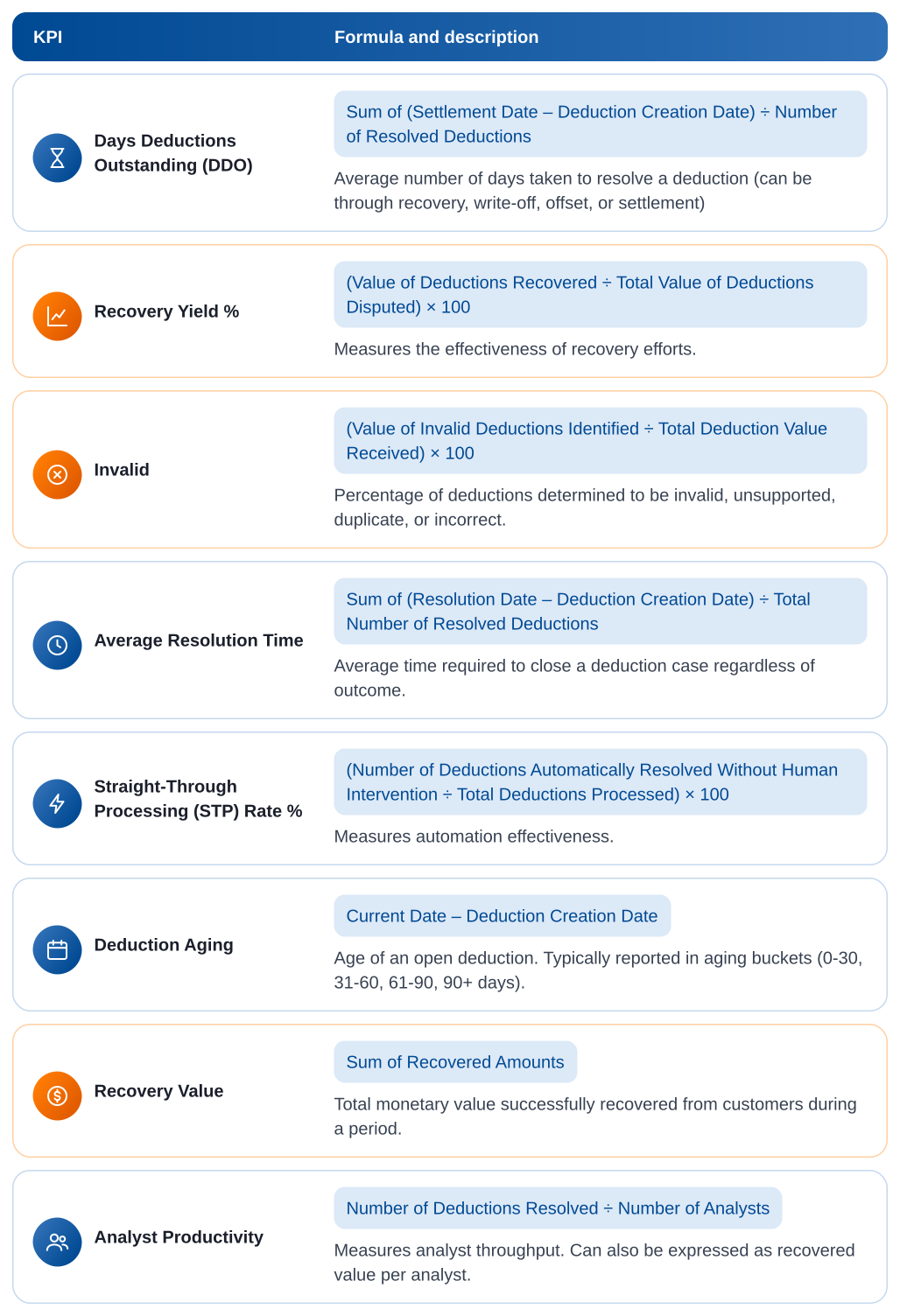
Measuring Success: KPIs That Matter
Turning Revenue Leakage into Working Capital Gains
Today, deduction management is an Accounts Receivable function. However, it has the potential to protect revenue, improve cash flow, and optimize working capital.
Organizations that continue to rely on spreadsheets, emails, and manual investigations will struggle to keep pace with increasing deduction volumes and shrinking recovery windows.
By combining workflow automation, intelligent document processing, business-rule validation, and Agentic AI, enterprises can automate dispute resolution, recover revenue faster, and gain complete visibility into the deduction lifecycle.
The future of deduction management is not simply processing deductions more efficiently. It is transforming deductions from a revenue-leakage problem into a working-capital optimization opportunity.
Ready to transform your deduction management process and recover more revenue?
Contact our team today to discover how AI-driven deduction management can maximize your working capital, accelerate dispute resolution, and improve recovery outcomes.
Related Blogs All Blogs

Managing Deductions in Order-to-Cash: A Practical Guide for Leaders
November 02, 2026

Overcoming AI Adoption Challenges in GBS Enterprises
Strategies for GBS, GCCs, and Shared Services to tackle AI adoption using a unified platform approach
July 21, 2025

Mamta Giriyappa Hunasikatti
Senior Product Manager
More blogs from Mamta Giriyappa >