The Hidden Costs of Inefficient Order Management and How to Eliminate It

Order management sits at the heart of your business, connecting customer demand to fulfillment through order capture, inventory visibility, processing, and delivery. When an order is delayed, inventory data is wrong, or a shipment misses its promised date, customers and the business both feel it.

Yet many businesses miss the full cost because it rarely shows up in one place. It’s scattered across write-offs, expedited freight, support tickets, refunds, and customers who quietly leave. One manual error or late shipment stops being small once you multiply it across thousands of orders.

So, what does your order process really cost you?

What Is Order Management, and Where Does It Go Wrong?

Order management is the end-to-end process of capturing, tracking, and fulfilling customer orders across channels while keeping demand, inventory, and delivery in step. It’s no longer a linear back-office function; it runs across ERPs, warehouses, and last-mile logistics, all expected to stay in sync.

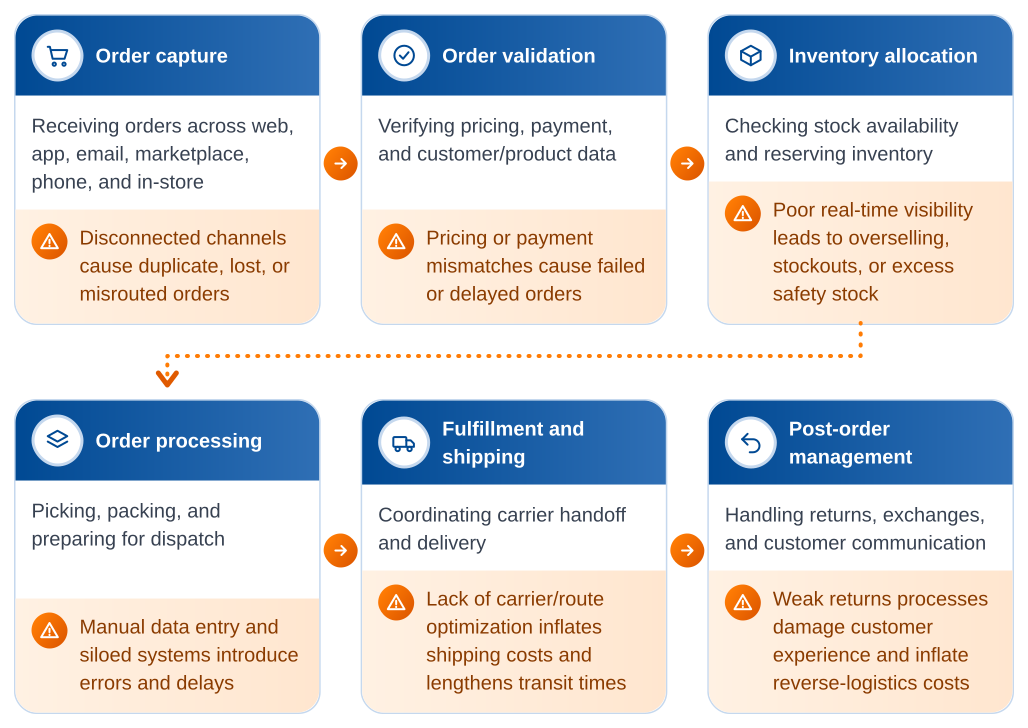
A typical workflow, and where it commonly breaks:
The Hidden Costs of Inefficient Order Management

Inefficiency costs your business in three ways:

It runs deeper too. Cash gets tied up in stock that isn’t moving, warehouse space fills with slow sellers, and support teams keep fixing the same problems, which hides the real cause. Because these costs are spread across departments, no one sees the full total, so it quietly compounds.

So where do these costs come from?

Most Common Root Causes of Inefficiency in Order Management

While every organization has its own order management challenges, the underlying issues are often surprisingly similar. In practice, most order delays, inventory discrepancies, and customer-service escalations can be traced back to a handful of recurring operational gaps.

How to Eliminate Inefficiency and Streamline Order Management

Most organizations don’t need a complete overhaul overnight. The biggest improvements often come from eliminating friction between systems, automating repetitive decisions, and giving teams real-time visibility into orders and inventory. When people spend less time searching for information and fixing errors, they can focus on serving customers and growing the business.

Real-World Success Stories

Infosys Topaz AI Next platform shows what order management transformation looks like at scale.

Our solution  empowers scalable agentic AI across enterprises, streamlining credit checks, invoicing, and collections while ensuring robust governance and seamless human-in-the-loop collaboration.

End-to-End Order Automation for a Global Manufacturer

A global manufacturer facing delayed responses and manual bottlenecks across its order lifecycle implemented end-to-end automation via AI Next.

The outcome: a 30% reduction in customer response time, achieved by removing manual handoffs across order capture, validation, and fulfillment.

Read more

Order Orchestration Across Complex Partner Networks

For enterprises managing complex partner and distributor networks, Our Order Orchestration solution delivered 8–10% higher order fill rates, 60% improvement in partner network visibility, and order response times reduced to 2 seconds—demonstrating how real-time orchestration directly compounds into fulfillment reliability.

Read more

Final thoughts

Order management has evolved from a transactional back-office function into a strategic business capability. Every order represents a customer expectation, and every delay, error, or missed commitment affects revenue, trust, and long-term loyalty. The companies that treat order management as a priority tend to win on cost, speed, and customer trust.

Ready to find where your orders are leaking?
Enhancing Customer Relationships Through Faster, Automated Dispute Resolution

Few moments reveal the strength of a company’s customer experience more clearly than when a dispute arises. Customers are often willing to overlook an occasional mistake, but how that mistake is handled can leave a lasting impression. A fair, transparent, and timely resolution often strengthens trust, while a poor experience can damage relationships that took years to build.

What frustrates customers most is usually not the dispute itself but the uncertainty around it. They want timely updates, clear ownership, and confidence that their issue is moving toward resolution.

This is where Agentic AI can make a meaningful difference. AI agents can proactively identify potential disputes, validate claims, detect duplicate submissions, gather evidence, generate recommendations, and help reduce overall resolution times while improving employee productivity.

Traditional Dispute Resolution: Why Manual and Rules-Based Approaches Fall Short

Most dispute management processes were designed for a very different business environment. As transaction volumes grow and customer expectations rise, teams are finding it increasingly difficult to keep pace using spreadsheets, email chains, and rigid business rules alone. What once worked well at a smaller scale can quickly become a bottleneck when disputes arrive in large numbers or involve multiple systems and stakeholders.

How Slow Resolution and Limited Visibility Damage Customer Trust

Delays in resolving disputes rarely affect just one transaction. What often starts as a simple billing disagreement can lead to repeated follow-ups, stalled payments, and growing frustration on both sides.

Legacy systems make this worse. In many organizations, resolving a dispute still requires people to piece together information from emails, phone calls, ERP systems, customer portals, and spreadsheets. Everyone involved may have part of the picture, but rarely the complete story. Customers are often left wondering about the status of their dispute, while internal teams spend valuable time searching for information rather than resolving issues.

This creates several challenges:

This lack of transparency increases inquiry volumes, prolongs resolution times, and negatively impacts the overall customer experience.

Agentic AI: Redefining Dispute Resolution for Customers

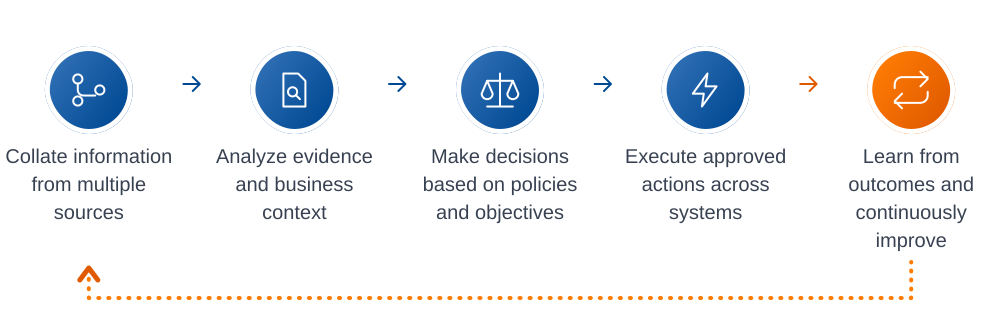
Agentic AI is a system of intelligent agents that can understand a business goal, reason through complex situations, plan actions, collaborate with other agents, and execute tasks autonomously while operating within defined business rules and governance controls.

Unlike traditional AI, which provides recommendations and waits for humans to act, Agentic AI can:

Think of Agentic AI as a team of digital specialists working alongside dispute analysts. Instead of simply surfacing information, these agents can gather evidence, identify similar cases, apply business policies, recommend next steps, and even carry out approved actions. This allows human teams to spend less time on administrative work and more time handling complex situations that require judgment and customer engagement.

Building Trust Through Transparency and Personalized Communication

Agentic AI improves transparency by tracking every action, proactively communicating progress, explaining decisions with supporting evidence, and keeping customers informed throughout the resolution process. It can also personalize updates, timelines, and recommendations based on each customer’s specific context.

For customers, this means fewer follow-up calls, greater confidence in the resolution process, and faster outcomes. For organizations, it translates into stronger relationships and a better overall customer experience.

Overcoming Implementation and Change Management Challenges

Despite the potential benefits, adopting Agentic AI is not without challenges. Most organizations face three common hurdles:

Organizations can preserve the human touch by automating only the tedious, time-consuming, and repetitive tasks, while leaving sensitive, judgment-intensive activities to human employees. It is also important to introduce explainability at every step, providing clear reasoning for why a particular claim was approved or rejected.

The most successful organizations deploy Agentic AI as a trusted partner rather than a replacement for people. AI handles speed, scale, investigation, and orchestration, while humans bring judgment, empathy, and relationship management. By combining autonomous resolution with explainability, governance, and proactive communication, organizations can accelerate dispute resolution, improve recovery outcomes, and build deeper customer trust without sacrificing the human element that drives lasting relationships.

The Future: Agentic AI as a Customer Relationship Game-Changer

As organizations continue to invest in AI, the conversation should move beyond efficiency alone. The real opportunity lies in using AI to strengthen trust, improve transparency, and create better customer experiences during moments that matter most.

Organizations that strike the right balance between autonomous AI and human expertise will be the ones that stand out. The goal is not to automate every decision, but to create a dispute resolution experience that is faster, more transparent, and ultimately more customer-centric.

Ready to resolve disputes faster?

See how Agentic AI can speed up your dispute resolution.

Managing Deductions in Order-to-Cash: A Practical Guide for Leaders

Few areas of the order-to-cash (O2C) process demand as much investigation and coordination as deduction management. Every deduction reduces the amount collected against an invoice, impacting cash flow, profitability, and customer relationships. As deduction volumes grow, teams often find themselves spending more time gathering information from emails, customer portals, remittance advice, and enterprise systems than actually resolving claims.

While workflow automation has improved efficiency, many organizations still rely on manual investigation and coordination. Cases take longer to resolve, backlogs grow, and valuable recovery opportunities are missed.

For business leaders, the question is straightforward: how can deductions be resolved faster without adding to analysts’ workload? Agentic AI offers a practical way forward.

How Agentic AI Is Transforming Deduction Management

Agentic AI refers to AI agents that can plan, act, and make decisions toward a defined goal, rather than simply following fixed rules.

The problem is rarely a lack of data. In most organizations, the information exists, but it is spread across ERPs, customer portals, email threads, and supporting documents, making it difficult to bring everything together quickly.

Agentic AI can ease the pressure on analysts by handling much of the initial investigation. It can gather supporting documents, validate claims, identify duplicate deductions, prioritize cases based on business impact, and recommend the next best action. Instead of spending hours collecting information, analysts can focus on exceptions, negotiations, and decisions that require human judgment.

Understanding Deductions and Their Impact

Organizations should separate deductions into two broad categories, as the root causes, data sources, ownership, and resolution processes are different:

Regardless of the cause, deductions delay cash collection because customers often withhold payment until a claim is resolved. This increases working capital requirements, extends deduction aging, reduces forecast accuracy, and puts added pressure on finance and accounts receivable teams.

Poorly managed disputes can also damage customer trust, while rapid and accurate resolution improves customer satisfaction and strengthens commercial relationships.

Where Traditional Processes Fall Short

Traditional deduction processes are often hindered by manual document retrieval, spreadsheet-driven tracking, fragmented data across systems, repetitive validation tasks, limited recovery prioritization, and a strong reliance on analyst expertise.

This way of working leaves teams exposed to several risks:

Consider a shortage claim that requires an invoice, shipment record, proof of delivery, and customer correspondence. If those records are spread across different systems and teams, analysts can spend days simply tracking down the information before the investigation really begins.

Automating Deduction Resolution: From Workflow Automation to Intelligent Resolution

Traditional automation is effective when the steps and rules are known in advance. Deduction cases are often less predictable: information may be missing, evidence may conflict, and the right decision may depend on customer-specific terms.

Agentic AI is designed to work through this complexity rather than simply move a case to the next step.

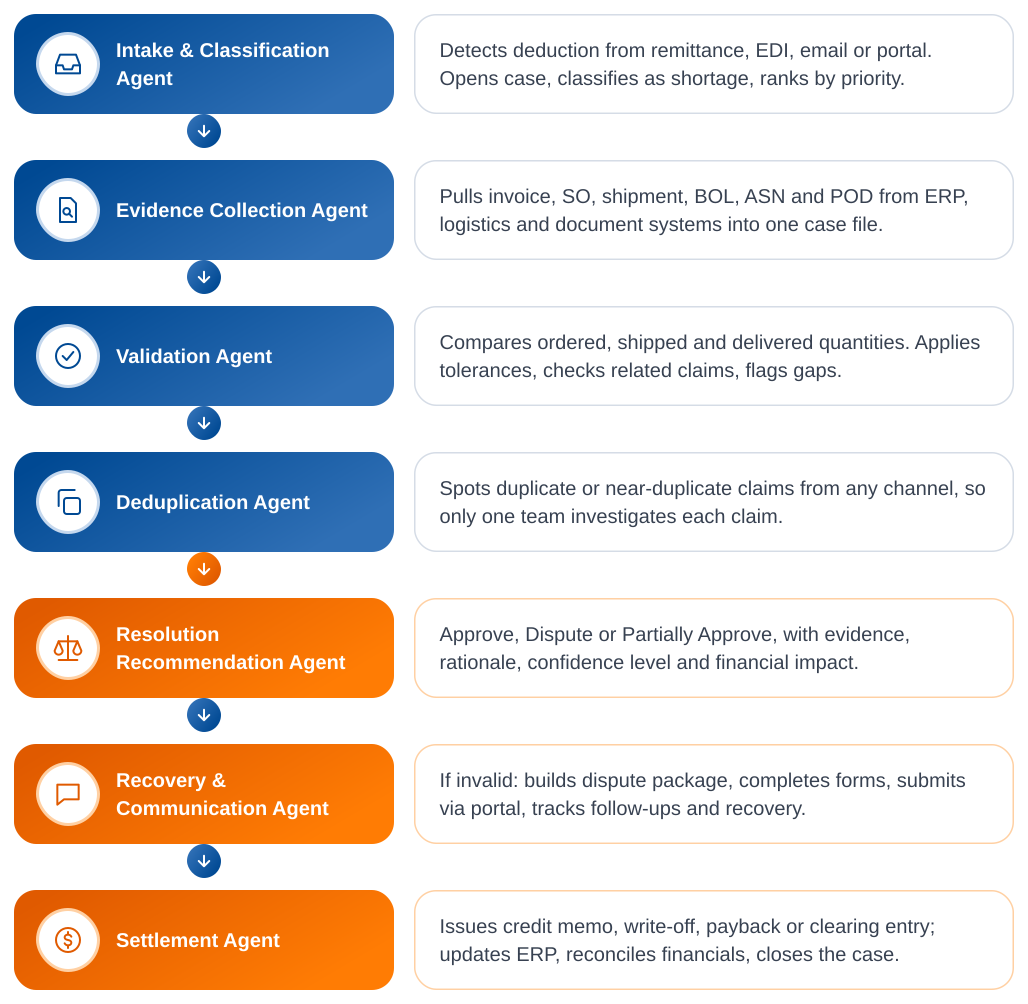
Consider a retailer submitting a $10,000 shortage deduction, claiming that fewer units were received than invoiced. In a traditional process, an analyst may spend hours, or even days, gathering documents from multiple systems, validating quantities, comparing shipment records, and preparing a dispute package.

With Agentic AI, specialized agents work together to resolve the deduction:

The Future of Deduction Management in O2C

Deduction management deserves to be treated as a revenue-protection function, not simply an accounts receivable activity. The goal is not simply to process deductions but to recover revenue faster, reduce write-offs, and improve working capital performance.

As the technology develops, analysts are likely to spend far less time gathering evidence, validating routine claims, routing cases, and reconciling outcomes. Their attention can shift to complex disputes, policy exceptions, and customer negotiations.

The best place to begin is with a clear business objective, whether that means recovering more revenue, reducing write-offs, accelerating cash collection, or lowering deduction aging. Organizations can prove value in one area, establish the necessary controls, and expand from there. With the right balance of automation, human judgment, and financial control, deduction management can become faster, more consistent, and far more effective at protecting revenue.

Recover more revenue and reduce write-offs with Agentic AI.