Walk through any large enterprise today and you’ll find the same paradox: more AI than ever, and more disconnection than ever. There’s a bot handling invoices in finance. A tool summarizing documents in legal. A chatbot fielding queries in customer service. Each one doing its job but none of them talking to each other.
That’s the silo problem,and it’s not new. Enterprises have spent decades wrestling with fragmented systems, disconnected data, and workflows that hand off between teams through email chains and manual follow-ups. The influx of AI tools, for all their promise, has largely inherited this problem rather than solved it. They’ve made individual tasks faster without making the overall process smarter.
This is precisely what agentic orchestration is designed to change — not by replacing what exists, but by connecting it. At its core, agentic orchestration is the coordinated management of AI agents, automation bots, enterprise systems, and human workers, all operating in concert to drive complex, multi-step business processes from start to finish. It’s the connective tissue between capability and outcome. The difference between AI that impresses in a demo and AI that transforms how an enterprise actually operates.
What is agentic orchestration, and what makes it different?
To understand agentic orchestration, it helps to start with what an AI agent actually is. An AI agent is a software entity that can perceive context, reason through a goal, take action across systems, and adapt based on what it learns — without requiring a human to script every step. Unlike a traditional automation bot that follows a fixed sequence of rules, an agent exercises judgment. It can handle ambiguity, work across multiple systems, and decide mid-process how to proceed.
That flexibility is powerful. But real enterprise processes are rarely simple enough for a single agent. A vendor onboarding spans document extraction, compliance checks, risk assessment, approvals, and system updates — often across five different platforms and three different teams. No single agent can manage all of that alone.
This is where multi-agent systems come in. Rather than one agent doing everything, you design a network of specialized agents — each purpose-built for a specific role — that collaborate to complete the process together. One agent extracts and validates documents. Another runs compliance checks. A third synthesizes findings and determines next steps. The right work goes to the right agent at the right moment.
Agentic orchestration is what coordinates that collaboration — reliably, at enterprise scale, with full visibility across every step. It’s what turns individual AI capability into collective enterprise intelligence.
How does agentic orchestration actually connect the enterprise?
The silo problem persists not because enterprises lack tools, but because those tools don’t share context. Every system handoff risks losing information. Every team boundary introduces delay. Orchestration solves this by aligning four core capabilities.
Real-time data access: Agents need seamless, secure, real-time access to enterprise data from any source to make decisions that are accurate and contextually relevant.
Memory: Agents use short-term memory to hold context within a task and long-term memory to retain past decisions, preferences, and institutional knowledge. Without it, every interaction resets. With it, agents build accumulated understanding — turning isolated tasks into continuously improving performance.
State management carries that intelligence forward.
As work moves across agents, state management preserves not just data but the meaning behind it — what was processed, what was decided, and what the next step requires. It prevents gaps and ensures continuity across the workflow.
Agentic AI frameworks provide the structure and coordination layer.
Different processes need different architectures, and below are some of the frameworks that help enable scalable, reliable agent orchestration.
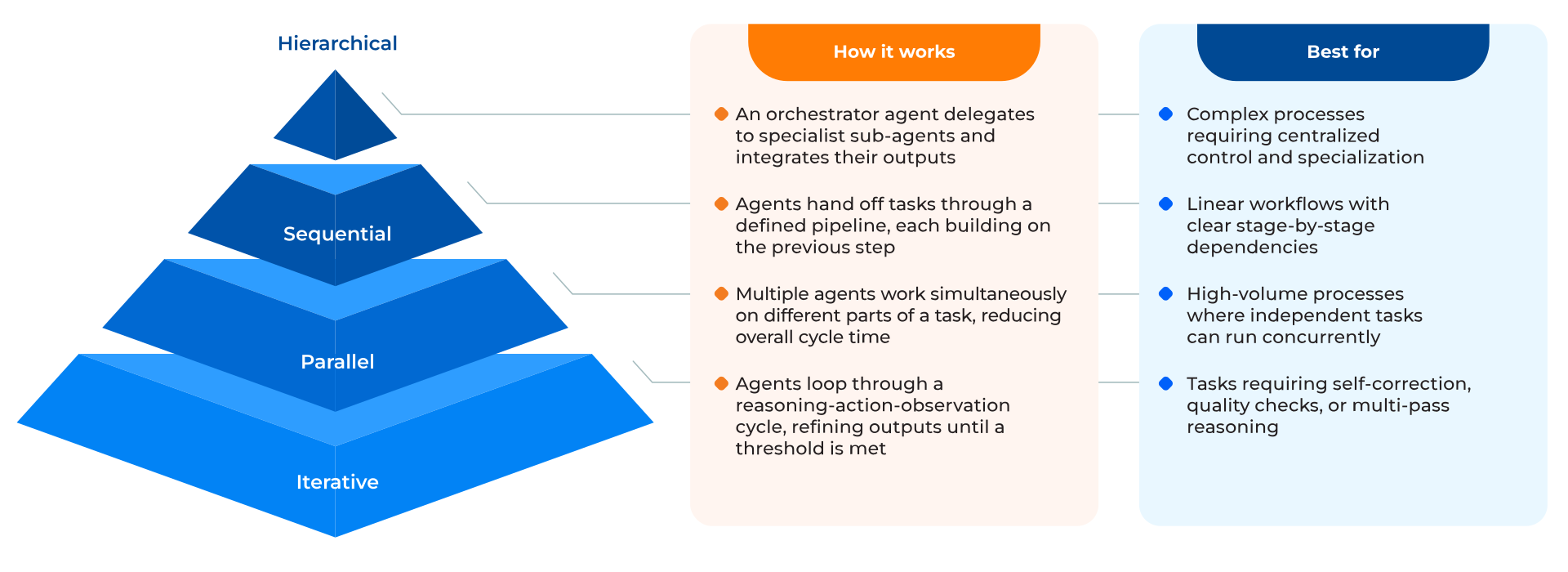
The A2A Protocol (Agent-to-Agent) is the communication standard that makes all of this interoperable. In most enterprises, technology isn’t homogeneous — different teams use different platforms, and agents sourced from different vendors need to work together seamlessly. The A2A Protocol provides the standard for agents to exchange tasks, share outputs, and coordinate actions regardless of the underlying technology. Combined, these four layers are what turn autonomous workflow orchestration from a concept into something production-ready across an entire enterprise — not just within a single tool or department.
How do enterprises manage agents at scale without losing oversight?
Connecting agents is one challenge. Trusting them to act — at scale, in production, on processes that carry real business, regulatory, and reputational weight — is another. This is where agentic governance and the right guardrails become the foundation of any serious enterprise deployment.
Autonomy isn’t binary. It exists on a spectrum — from agents that advise and wait for human sign-off, to agents that handle routine tasks independently and escalate exceptions, to agents that manage entire workflows end to end. Where an organization positions its agents on that spectrum should be deliberate, process-specific, and always revisable. The goal isn’t maximum autonomy; it’s the right autonomy for each context.
The human-in-the-loop/ human-on-the-loop model is what makes this work responsibly. Well-designed agentic systems define precisely where human judgment is required and build those checkpoints into the workflow by design. Agents handle the well-defined, high-volume work autonomously — but at genuinely critical decision points, the workflow surfaces the situation to a human before proceeding. Over time, as trust is built and patterns are validated, the level of autonomy can expand. The ability to intervene, however, is always there by design. This balance is what’s known as controlled autonomy — giving agents the freedom to act within the boundaries that the enterprise defines, trusts and can always adjust.
Governance makes this trustworthy at scale. Every agent action is logged in a tamper-evident audit trail. Behavioral guardrails enforce that agents only access the data and systems their role permits — nothing more. Observability dashboards provide real-time visibility into how every workflow is behaving — not just whether it completed, but how — so issues are identified before they escalate. Systematic evaluations, ongoing assessments of agent behavior against accuracy, performance, and safety benchmarks, ensure the system continuously improves and any drift from expected behavior is caught early. A responsible AI framework governs operations across design, build, and runtime: fairness checks to detect bias, explainability mechanisms so decisions are understandable, and privacy controls that govern how agents handle sensitive data throughout a workflow.
Why does a unified platform make all the difference?
The capabilities that make agentic orchestration work only deliver value when they work together. Enterprises that try to assemble this from multiple disconnected tools end up with a different kind of silo — fragmented workflows, inconsistent governance, and systems that are hard to scale. A unified platform approach changes this: when orchestration, agent management and governance all sit on the same foundation, enterprises gain a coherent connected enterprise operation rather than another layer of complexity to manage.
How does EdgeVerve AI Next bring this all together?
EdgeVerve AI Next, a unified, scalable platform, enables enterprises to move from siloed AI experiments to a coordinated, governed, production-ready agentic operation.
The platform provides a unified environment where agents, bots, data, and humans work together as a coherent workforce — not tools stitched together, but an integrated system with a single governance layer across all of it. Its orchestration engine supports the full range of multi-agent frameworks so organizations can design systems that match how their processes actually work, not how a platform constrains them.
The full agent lifecycle management — from design and deployment through monitoring, optimization, and retirement — happens within the same platform, eliminating the agent sprawl that accumulates when deployments are fragmented across tools.
The governance infrastructure is built in from the ground up: behavioral guardrails at the infrastructure layer, real-time observability and monitoring dashboards, continuous evaluation frameworks, and a responsible AI framework that enforces fairness, explainability, and compliance at every stage. Human-in-the-loop/human-on-the-loop controls can be configured precisely — ensuring teams stay in control of the decisions that genuinely require human judgment, without becoming a bottleneck for the ones that don’t.
The era of siloed enterprise AI is ending, with agentic orchestration providing the layer that connects, governs, and unifies every tool into a smarter system.
See how EdgeVerve AI Next powers enterprise agentic orchestration.
