Home > Blogs > Enhancing Customer Relationships Through Faster, Automated Dispute Resolution
Enhancing Customer Relationships Through Faster, Automated Dispute Resolution

Table of Contents
Few moments reveal the strength of a company’s customer experience more clearly than when a dispute arises. Customers are often willing to overlook an occasional mistake, but how that mistake is handled can leave a lasting impression. A fair, transparent, and timely resolution often strengthens trust, while a poor experience can damage relationships that took years to build.
What frustrates customers most is usually not the dispute itself but the uncertainty around it. They want timely updates, clear ownership, and confidence that their issue is moving toward resolution.
This is where Agentic AI can make a meaningful difference. AI agents can proactively identify potential disputes, validate claims, detect duplicate submissions, gather evidence, generate recommendations, and help reduce overall resolution times while improving employee productivity.
Traditional Dispute Resolution: Why Manual and Rules-Based Approaches Fall Short
Most dispute management processes were designed for a very different business environment. As transaction volumes grow and customer expectations rise, teams are finding it increasingly difficult to keep pace using spreadsheets, email chains, and rigid business rules alone. What once worked well at a smaller scale can quickly become a bottleneck when disputes arrive in large numbers or involve multiple systems and stakeholders.
How Slow Resolution and Limited Visibility Damage Customer Trust
Delays in resolving disputes rarely affect just one transaction. What often starts as a simple billing disagreement can lead to repeated follow-ups, stalled payments, and growing frustration on both sides.
Legacy systems make this worse. In many organizations, resolving a dispute still requires people to piece together information from emails, phone calls, ERP systems, customer portals, and spreadsheets. Everyone involved may have part of the picture, but rarely the complete story. Customers are often left wondering about the status of their dispute, while internal teams spend valuable time searching for information rather than resolving issues.
This creates several challenges:
This lack of transparency increases inquiry volumes, prolongs resolution times, and negatively impacts the overall customer experience.
Agentic AI: Redefining Dispute Resolution for Customers
Agentic AI is a system of intelligent agents that can understand a business goal, reason through complex situations, plan actions, collaborate with other agents, and execute tasks autonomously while operating within defined business rules and governance controls.
Unlike traditional AI, which provides recommendations and waits for humans to act, Agentic AI can:
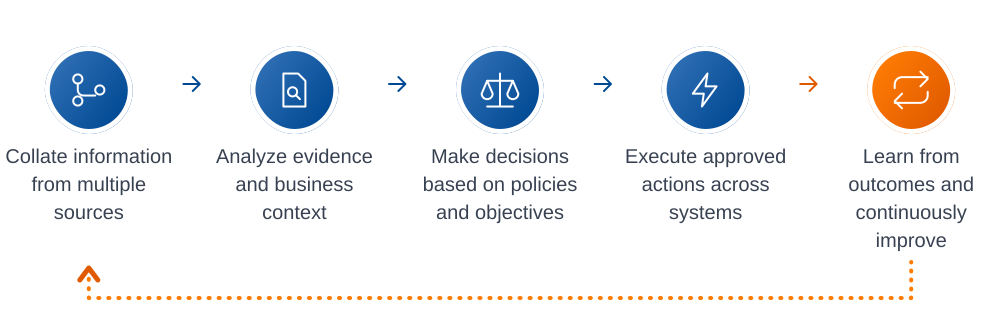
Think of Agentic AI as a team of digital specialists working alongside dispute analysts. Instead of simply surfacing information, these agents can gather evidence, identify similar cases, apply business policies, recommend next steps, and even carry out approved actions. This allows human teams to spend less time on administrative work and more time handling complex situations that require judgment and customer engagement.
Building Trust Through Transparency and Personalized Communication
Agentic AI improves transparency by tracking every action, proactively communicating progress, explaining decisions with supporting evidence, and keeping customers informed throughout the resolution process. It can also personalize updates, timelines, and recommendations based on each customer’s specific context.
For customers, this means fewer follow-up calls, greater confidence in the resolution process, and faster outcomes. For organizations, it translates into stronger relationships and a better overall customer experience.
Overcoming Implementation and Change Management Challenges
Despite the potential benefits, adopting Agentic AI is not without challenges. Most organizations face three common hurdles:
Organizations can preserve the human touch by automating only the tedious, time-consuming, and repetitive tasks, while leaving sensitive, judgment-intensive activities to human employees. It is also important to introduce explainability at every step, providing clear reasoning for why a particular claim was approved or rejected.
The most successful organizations deploy Agentic AI as a trusted partner rather than a replacement for people. AI handles speed, scale, investigation, and orchestration, while humans bring judgment, empathy, and relationship management. By combining autonomous resolution with explainability, governance, and proactive communication, organizations can accelerate dispute resolution, improve recovery outcomes, and build deeper customer trust without sacrificing the human element that drives lasting relationships.
The Future: Agentic AI as a Customer Relationship Game-Changer
As organizations continue to invest in AI, the conversation should move beyond efficiency alone. The real opportunity lies in using AI to strengthen trust, improve transparency, and create better customer experiences during moments that matter most.
Organizations that strike the right balance between autonomous AI and human expertise will be the ones that stand out. The goal is not to automate every decision, but to create a dispute resolution experience that is faster, more transparent, and ultimately more customer-centric.
Ready to resolve disputes faster?
See how Agentic AI can speed up your dispute resolution.
Related Blogs All Blogs

Connecting the Dots: Transforming Fragmented Insurance Operations into Seamless Customer Journeys
October 05, 2026
Your IDP Pilot Worked. So Why Isn’t It in Production?
August 31, 2026

Mamta Giriyappa Hunasikatti
Senior Product Manager
More blogs from Mamta Giriyappa >