Home > Blogs > Managing Deductions in Order-to-Cash: A Practical Guide for Leaders
Managing Deductions in Order-to-Cash: A Practical Guide for Leaders

Table of Contents
Few areas of the order-to-cash (O2C) process demand as much investigation and coordination as deduction management. Every deduction reduces the amount collected against an invoice, impacting cash flow, profitability, and customer relationships. As deduction volumes grow, teams often find themselves spending more time gathering information from emails, customer portals, remittance advice, and enterprise systems than actually resolving claims.
While workflow automation has improved efficiency, many organizations still rely on manual investigation and coordination. Cases take longer to resolve, backlogs grow, and valuable recovery opportunities are missed.
For business leaders, the question is straightforward: how can deductions be resolved faster without adding to analysts’ workload? Agentic AI offers a practical way forward.
How Agentic AI Is Transforming Deduction Management
Agentic AI refers to AI agents that can plan, act, and make decisions toward a defined goal, rather than simply following fixed rules.
The problem is rarely a lack of data. In most organizations, the information exists, but it is spread across ERPs, customer portals, email threads, and supporting documents, making it difficult to bring everything together quickly.
Agentic AI can ease the pressure on analysts by handling much of the initial investigation. It can gather supporting documents, validate claims, identify duplicate deductions, prioritize cases based on business impact, and recommend the next best action. Instead of spending hours collecting information, analysts can focus on exceptions, negotiations, and decisions that require human judgment.
Understanding Deductions and Their Impact
Organizations should separate deductions into two broad categories, as the root causes, data sources, ownership, and resolution processes are different:
Regardless of the cause, deductions delay cash collection because customers often withhold payment until a claim is resolved. This increases working capital requirements, extends deduction aging, reduces forecast accuracy, and puts added pressure on finance and accounts receivable teams.
Poorly managed disputes can also damage customer trust, while rapid and accurate resolution improves customer satisfaction and strengthens commercial relationships.
Where Traditional Processes Fall Short
Traditional deduction processes are often hindered by manual document retrieval, spreadsheet-driven tracking, fragmented data across systems, repetitive validation tasks, limited recovery prioritization, and a strong reliance on analyst expertise.
This way of working leaves teams exposed to several risks:
Consider a shortage claim that requires an invoice, shipment record, proof of delivery, and customer correspondence. If those records are spread across different systems and teams, analysts can spend days simply tracking down the information before the investigation really begins.
Automating Deduction Resolution: From Workflow Automation to Intelligent Resolution
Traditional automation is effective when the steps and rules are known in advance. Deduction cases are often less predictable: information may be missing, evidence may conflict, and the right decision may depend on customer-specific terms.
Agentic AI is designed to work through this complexity rather than simply move a case to the next step.
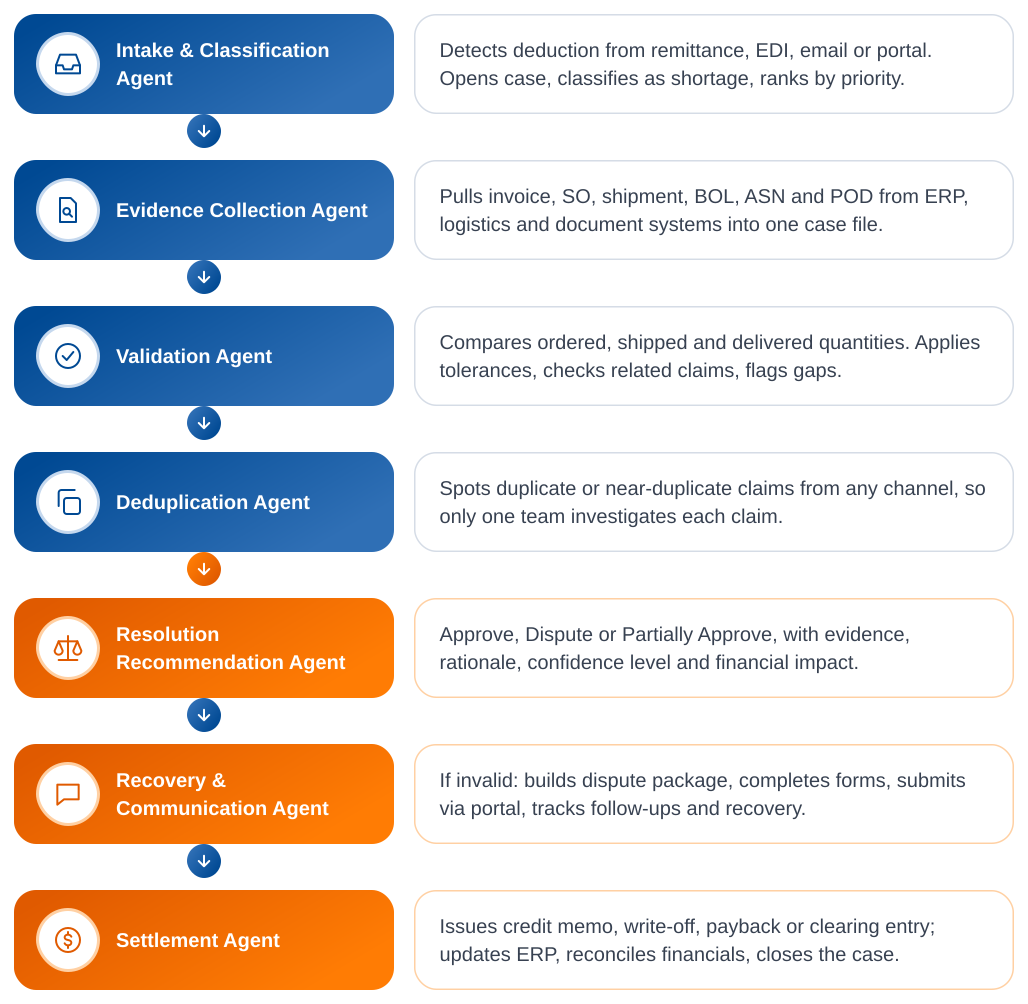
Consider a retailer submitting a $10,000 shortage deduction, claiming that fewer units were received than invoiced. In a traditional process, an analyst may spend hours, or even days, gathering documents from multiple systems, validating quantities, comparing shipment records, and preparing a dispute package.
With Agentic AI, specialized agents work together to resolve the deduction:
The Future of Deduction Management in O2C
Deduction management deserves to be treated as a revenue-protection function, not simply an accounts receivable activity. The goal is not simply to process deductions but to recover revenue faster, reduce write-offs, and improve working capital performance.
As the technology develops, analysts are likely to spend far less time gathering evidence, validating routine claims, routing cases, and reconciling outcomes. Their attention can shift to complex disputes, policy exceptions, and customer negotiations.
The best place to begin is with a clear business objective, whether that means recovering more revenue, reducing write-offs, accelerating cash collection, or lowering deduction aging. Organizations can prove value in one area, establish the necessary controls, and expand from there. With the right balance of automation, human judgment, and financial control, deduction management can become faster, more consistent, and far more effective at protecting revenue.
Recover more revenue and reduce write-offs with Agentic AI.
Related Blogs All Blogs

Document AI: Powering Intelligent, Scalable Workflows Across Industries
July 13, 2026

Beyond Size: Small Language Models, Big Enterprise Impact
February 06, 2025

Joseph John Valiaveetil
Senior Analyst - Product Management
More blogs from Joseph John Valiaveetil >