Vision
Vision activity is used to perform AI based image analysis. In this activity, you can process the images and retrieve information from images, such as, payee in the cheque, amount in the cheque, with the help of the cognitive vision API.
Using Vision Activity
1. In the Canvas Tools pane, click Process Components to expand and view the associated activities.
2. Drag the Application activity and drop on to the Flowchart designer area on the Canvas.
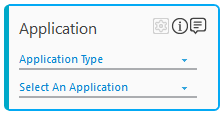
3. In the Application Type list, select CognitiveApps.
4. In the Select An Application list, select the application.
5. Double-click the Application activity to add Vision activity as cognitive activities works inside the application activity.
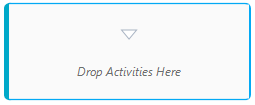
6. In the Canvas Tools pane, click Cognitive Services to expand the tool and view the associated activities.
7. Drag the Vision activity and drop on to the Flowchart designer area on the Canvas.
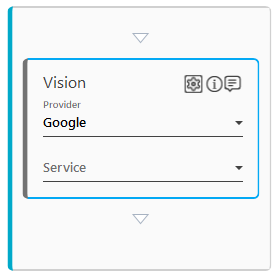
8. In the Provider list, select the Provider name. By default, Provider is set to Google.
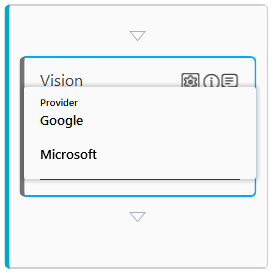
Automation Studio supports two service providers for cognitive vision API.
· Microsoft
9. In the Service list, select the service which you want to use for cognitive vision API.
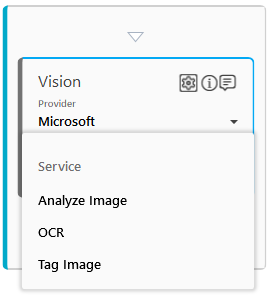
Based on your selection of provider, service list reflects the supported APIs. If you have selected Google as your provider, following API services will reflect in the service list:
· Analyze Image: This API extracts a rich set of visual features based on the image content. You can analyze APIs, such as, categories detection, label detention, face detection, SafeSearch detection, by selecting an appropriate visual feature in the configuration window.
If you have selected Microsoft as your provider, following API services will reflect in the service list:
· Analyze Image: This API extracts a rich set of visual features based on the image content. You can analyze APIs, such as, categories detection, label detention, face detection, SafeSearch detection, by selecting an appropriate visual feature in the configuration window.
· OCR: Optical Character Recognition (OCR) detects text in an image and extracts the recognized characters into a machine usable character stream.
· Tag Image: The API generates a list of words, or tags, that are relevant to the content of the provided image.
10. Click
the  (Settings) icon. The Configuration
window appears.
(Settings) icon. The Configuration
window appears.
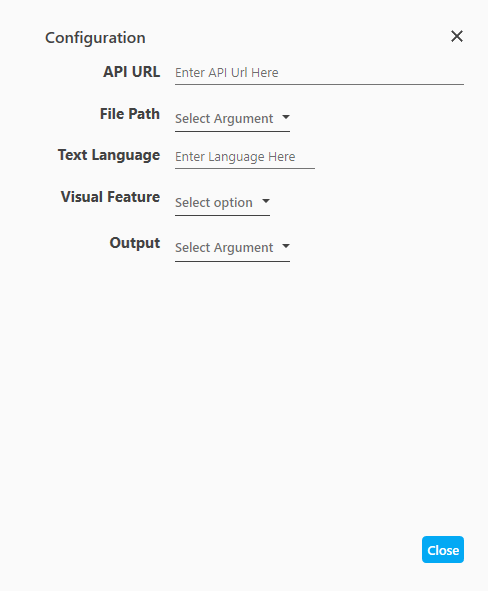
a. API URL: Provide API URL based on the provider and service selected by you in the Vision activity.
b. File Path: Provide image path for analyzing the image. This is an input for your API. You can provide image path by creating argument in the Arguments pane, and then select the created argument in the File Path list.
c. Text Language: This is an optional parameter and applicable for OCR and text detection visual features. You can keep it blank for auto detect. You can define text in following format, such as, en-US. bdepicts English and US depicts United States. As a whole, OCR detects US English.
d. Output: Provide the JSON file to store the output. This is an output of your API. You can provide the JSON file for output by creating argument in the Argument pane and then select the created argument in the Output list.
e. Visual Feature: Select the visual feature from the list, such as, categories, Adult, Color. This list contains the visual features API list. Appears if Service selected is Analyze Image.
The above mentioned parameters may vary as per your selection.
11. Click Close to confirm your changes.
Vision Properties
The properties of Vision activity are listed in the following table and can be edited in the Properties grid on the right pane.
Property Name |
Usage |
Control Execution |
|
Ignore Error |
When this option is set to Yes, the application ignores any error while executing the activity. If set to NA, it bypasses the exception (if any) to let the automation flow continue; however, it marks the automation status as failure, in case of an exception. By default, this option is set to No. |
Delay |
|
Wait After (ms) |
Specify the time delay that must occur after the activity is executed. The value must be in milliseconds. |
Wait Before (ms) |
Specify the time delay that must occur before the activity is executed. The value must be in milliseconds. |
Misc |
|
ApplicationID |
It is internally created and managed by Automation Studio itself. |
Breakpoint |
Select this option to mark this activity as the pause point while debugging the process. At this point, the process freezes during execution allowing you to examine if the process is functioning as expected. In large or complex processes, breakpoints help in identifying the error, if any. |
Commented |
Select this option to mark this activity as inactive in the entire process. When an activity is commented, it is ignored during the process execution. |
DisplayName |
The display name of the activity in the flowchart designer area. By default, the name is set as Vision. You can change the name as required. |
FilePath |
Specify the file path for the input. Alternatively, you can specify the file path by selecting the argument holding file path, in the Input list of the Configuration window. The file path specified in the Properties grid reflects in the Configuration window and vice versa. |
ResultJson |
Specify the JSON file path to store the JSON output. Alternatively, you can specify the JSON file path by selecting the argument holding file path, in the Output list of the Configuration window. The file path specified in the Properties grid reflects in the Configuration window and vice versa. |
SelectedService |
The name of the service selected in the language activity box. You can change the name as required. |
TextLanguage |
Specify the text language in this field. The format to define the text language is en-US. Alternatively, you can enter the text language in the Text Language field of the Configuration window. The text language entered in the Properties grid reflects in the Configuration window and vice versa. |
Url |
Specify the API URL in the field. Alternatively, you can specify the API URL by selecting the argument holding the API URL, in the API URL list of the Configuration window. The API URL specified in the Properties grid reflects in the Configuration window and vice versa. |
VisualFeature |
The name of the visual feature selected in the Visual Feature list of configuration window is displayed. |
See Also
Refer the below links to learn more about the supported languages in vision activity,
Google: https://cloud.google.com/vision/docs/reference/rest/v1/images/annotate
Google Vision API: https://cloud.google.com/vision/docs/languages
Microsoft Analyze Image API: https://westus.dev.cognitive.microsoft.com/docs/services/56f91f2d778daf23d8ec6739/operations/56f91f2e778daf14a499e1fa
Microsoft OCR API: https://westus.dev.cognitive.microsoft.com/docs/services/56f91f2d778daf23d8ec6739/operations/56f91f2e778daf14a499e1fc
On This Page Hide
Related Topics